Luxury Preserved Flowers | NYC Studio


Preserved Roses vs. Fresh Roses: Which Is Actually Worth It?
There's a version of this debate that's very simple: fresh roses smell better. Everything else? Preserved wins.
But let's not skip the nuance. Both have their place, and depending on what you're looking for, a romantic gesture that lasts ten days or a design piece that lasts two years, the right answer is different. This guide breaks down every meaningful difference between preserved and fresh roses so you can make the call yourself. It also covers what eternity roses are, what each color means, and how to style and care for preserved roses at home.
What's the Actual Difference?
A fresh rose is cut from the stem and placed in water. From that moment, it's in slow decline. The cells are no longer receiving nutrients from the root system, so they begin to break down, petals loosen, color fades, stem softens. With good care (fresh water, trimmed stems, away from direct heat), most fresh roses look their best for 5–7 days and are visibly past their peak within 10.
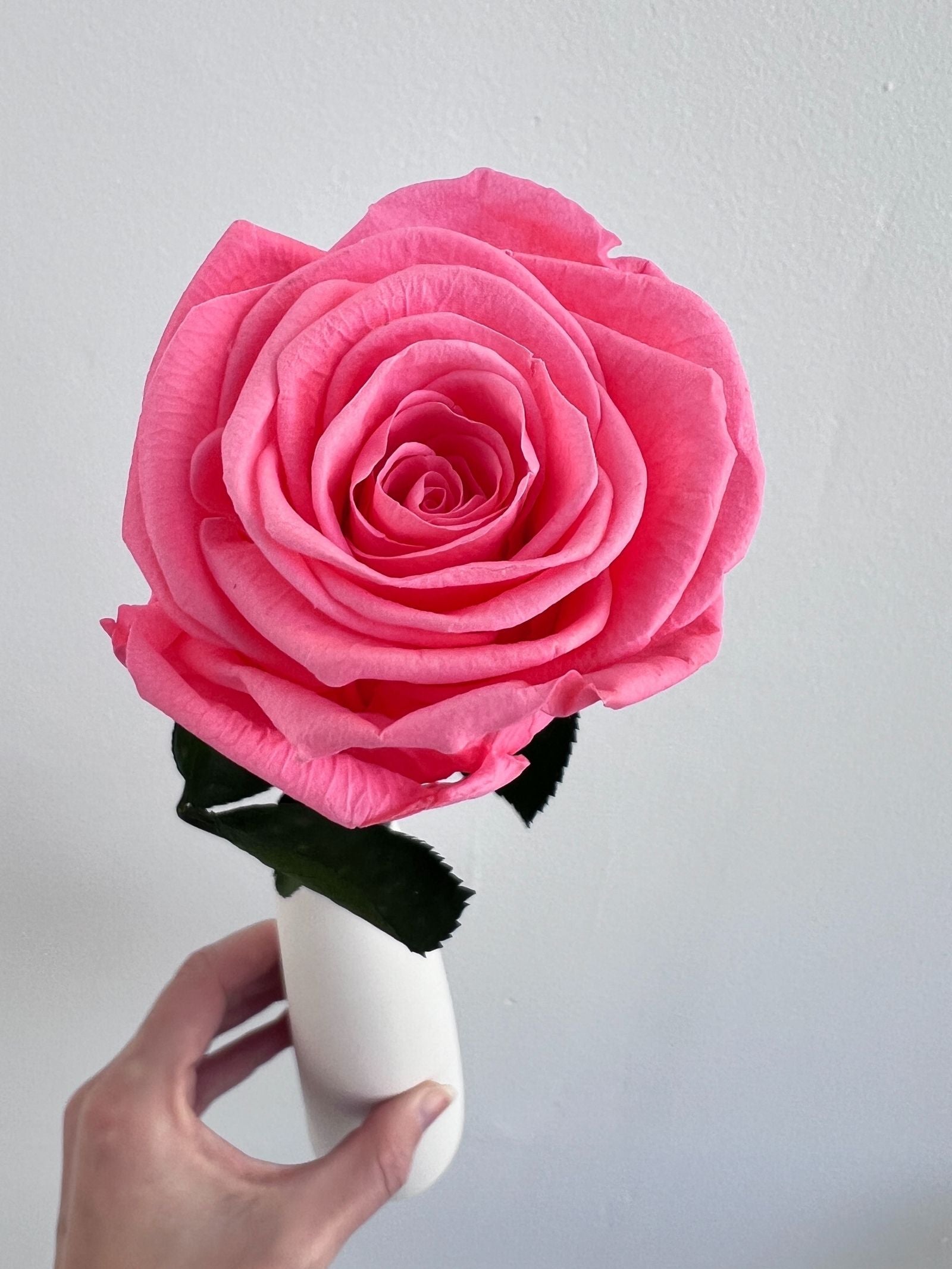
A preserved rose starts the same way, it's a real, botanically grown rose, selected at peak bloom. But instead of being placed in water, it goes through a preservation process. The flower's natural sap is replaced with a plant-based glycerin solution that keeps the petals soft, the color vivid, and the form intact. No more cellular breakdown. No more decline. The rose is, in effect, frozen at its best moment.
The result: a flower that looks and feels like it arrived from a florist today, and, with care, will still look that way for 1 to 3 years.
The Honest Comparison: Side by Side
| Preserved Roses | Fresh Roses | |
|---|---|---|
| Lifespan | 1–3 years | 5–10 days |
| Are they real? | Yes — real roses | Yes — real roses |
| Texture | Soft, velvet-like petals | Soft, natural |
| Scent | Minimal (fragrance removed in process) | Natural rose scent |
| Water needed | Never — water damages them | Daily |
| Maintenance | None | Trim stems, change water every 2 days |
| Pollen-free | Yes (no pollen, no fragrance) | No |
| Color range | Extensive (dyed during preservation) | Natural |
| Cost over 1 year | One purchase | 25–50 replacements |
| Best for | Gifting, home décor, milestones | Immediate occasions, fragrance lovers |
| Shipping | Ships well — no water, no refrigeration | Limited — time-sensitive, fragile |
The one genuine advantage fresh roses hold is scent. If the smell of a rose is a non-negotiable part of the experience for you, that matters. For everything else, longevity, maintenance, design flexibility, value, preserved is the better option.
And dried roses?
A dried rose has had its moisture taken out and nothing put back. The petals turn papery and brittle, the color softens to a muted, vintage tone, and a knock can shatter a bloom. A preserved rose has its sap replaced with glycerin instead, so the petals stay soft and the color stays full. Dried roses have a charm of their own. They just do not look like a rose in bloom.
What Are Preserved Roses, and How Do They Work?
A preserved rose is a real rose that has been treated to keep its soft petals and color for 1 to 3 years. Nothing is swapped for silk or plastic. It is the same flower, kept close to how it looked the day it was cut.
Here is how it works. The rose is picked at peak bloom. Its natural sap is replaced with a plant-based glycerin solution, and food-safe dyes set the color, from crisp white to taffy pink. The glycerin keeps the petals supple, which is why a preserved rose feels soft rather than papery.
That process shapes how you live with one. No water. No trimming. Most have little to no scent, because the sap that carries the fragrance is gone. Keep yours indoors, out of direct sun, and away from humidity and vents. A console or a bookshelf away from the window suits it well.
What Are Eternity Roses?


You'll see terms like eternity roses, forever roses, and infinity roses used interchangeably, and they all refer to the same thing: preserved roses.
The terminology became popular through luxury floral brands packaging preserved roses in high-end boxes and gift formats, and the names stuck as a category shorthand. An eternity rose is a preserved rose. A forever rose is a preserved rose. There's no separate technique or process, just different branding.
At Nordblooms, our preserved rose collection includes everything from single crystal-box presentations to large statement vase arrangements. The Crystal Rose, a single preserved rose in an acrylic gift box, is one of our most popular gift formats and exactly the kind of piece the "eternity rose" category describes.
What distinguishes quality eternity roses from lower-end versions: the bloom itself (picked at peak, not harvested early), the preservation solution used, and the color consistency throughout the petals. Cheap preserved roses often show uneven coloring or become brittle within months. Premium preserved roses maintain soft petals and consistent color well into their second year.
You will also see them sold as eternal roses or everlasting roses. Same flower, same process. The name on the box tells you about the brand, not the rose.
Are Preserved Roses Real Flowers?
Yes — completely. This is one of the most common questions we get, and the answer is straightforward.
Preserved roses are grown, harvested, and handled exactly like any fresh rose up until the preservation stage. They're real flowers. The preservation process is a treatment applied to the bloom, not a replacement of it with something artificial.
The difference from silk or artificial roses is total. Silk roses are manufactured from fabric. Preserved roses are actual botanical material — you can see the petal veining, feel the natural texture, and appreciate the organic irregularity that makes real flowers beautiful. Artificial flowers look artificial. Preserved flowers look alive.
How Long Do Preserved Roses Actually Last?


Under normal indoor conditions, most preserved roses last 1–2 years. Under ideal conditions, indoors, away from direct sunlight and humidity, many last 2–3 years.
The main factors that shorten the lifespan:
Direct sunlight is the biggest one. UV rays break down the pigments in preserved petals faster than anything else. Even a south-facing window that doesn't feel intensely bright will cause fading over months. Keep preserved roses in a spot where they're away from direct light.
Humidity is the second. Preserved roses should never be in bathrooms, near kettles, or in rooms that get consistently humid. The glycerin solution can reactivate in high moisture, causing petals to become tacky or droop.
Physical contact, the natural oils from fingertips transfer to petals and cause gradual discoloration. An arrangement that's touched frequently will age faster than one that's left undisturbed.
For more detail on care, read our full guide: How Long Do Preserved Flowers Last.
Are Preserved Roses Worth the Price?


Let's do the actual math.
A fresh rose bouquet of moderate quality in NYC runs about $40–$60 and lasts around 7 days. Over a year, to maintain fresh roses consistently, you're spending $2,000–$3,000.
A $129 Nordblooms preserved rose lasts 1 to 3 years with care. Counted over just one year, that is about $0.35 a day. A $60 fresh bouquet lasting 7 days is $8.57 per day.
Even ignoring the cost of your time, the trips to the florist, the stem trimming, the water changes, the weekly disposal, preserved roses are cheaper by a factor of 20 or more.
The upfront cost is higher. The actual cost is dramatically lower. For anyone who keeps flowers in their home regularly, preserved roses aren't a luxury upgrade. They're the more economical choice.
Browse our preserved roses under $99 if you want to start with a smaller piece, or our luxury preserved rose arrangements for something more statement-making.
When to Choose Fresh, When to Choose Preserved

Choose fresh roses when:
- Scent is a central part of the gift — for a rose lover who specifically values fragrance, fresh is irreplaceable
- The occasion is very immediate — a dinner table, an event happening tonight, a gesture that's about the moment
- Budget is very tight and longevity doesn't matter
Choose preserved roses when:
- You want the gift to last — birthdays, anniversaries, housewarmings, milestones
- You're sending to someone far away — our single-stem roses and Crystal Roses ship across the contiguous US without refrigeration and arrive in perfect condition
- The recipient is busy, low-maintenance, or lives in a small NYC apartment without space for vase upkeep
- You're decorating a home or office and want something that doesn't need replacing
- You want to give something that will genuinely be remembered
For anniversary flowers, birthday arrangements, housewarming gifts, or gifts for her — preserved roses are consistently the better choice. They carry emotional staying power that a wilting fresh bouquet simply can't match.
What Each Rose Color Means
A preserved rose stays in someone's home for 1 to 3 years, so the color is part of the message. These are the shades we work with in the studio:
- Red and burgundy: love and devotion. The anniversary and Valentine's Day rose, and the boldest accent in a white room.
- Pink, from powder to fuchsia: admiration, gratitude, and warmth. French pink and taffy pink are the easiest to give, to almost anyone, for almost any reason.
- White and cream: new beginnings and quiet respect. The natural choice for a new home, a wedding, or a calm, neutral interior.
- Peach: sincerity and thanks. Softer than pink, and lovely in warm, earthy rooms.
- Crystal blue: calm and the unexpected. Blue roses do not grow in nature, so the color itself says you chose something rare.
For more on choosing a shade, read what preserved rose colors mean.
How to Style Preserved Roses at Home
Think of a preserved rose the way you would a lamp or a piece of ceramic. It is part of the room now, so place it with the same care.
One stem, one vessel. A single long-stem rose in a bud vase is not a smaller version of a bouquet. It is a decision. It suits a nightstand, a desk, or a vanity shelf, anywhere a full arrangement would crowd the surface. Our long-stem preserved flowers are made for this.
A full arrangement as an anchor. A larger piece belongs on a console, an entryway table, or the center of a dining table. Give it room. With clear space around it, it reads as the finishing touch; crowded by ten other objects, it gets lost. See our preserved vase arrangements.
The vessel is half the piece. A beautiful rose in a generic container still looks generic. We design every arrangement with its vase, from white ceramic bud vases to silver mirror bowls, so the two belong together.
Match the color to the room. Cream and blush settle into almost any interior. Red works best as a deliberate contrast, against white walls or beside dark wood. For more ideas, room by room, read how to decorate with preserved flowers.
How to Care for Preserved Roses
There is very little to do, which is the point. Four habits keep a preserved rose soft and full for as long as possible:
- Never add water. No water in the vase, no misting. Moisture breaks down the glycerin that keeps the petals soft.
- Keep it out of direct sun. A spot a few feet back from the window is ideal. A sunny windowsill can fade the color within weeks.
- Avoid steam and heat. Keep it out of bathrooms and away from the stove, radiators, and vents. An ordinary heated or air-conditioned room is perfect.
- Dust gently. Every few months, use a soft, dry brush or a hair dryer on its cool setting, held well back. Nothing damp, and no sprays.
Our care page covers the rest.
Our Preserved Roses
Every rose arrangement is handmade in our New York studio. A few to start with:
- The Crystal Rose ($69): a single rose in a clear acrylic box, in powder pink, taffy pink, fuchsia, or crystal blue. The easiest gift here.
- The Classic Rose (from $99): one long-stem rose in a tall bud vase, in burgundy red, French pink, fuchsia, white, or crystal blue.
- The Classic Belle Rose ($129): a fuller red bloom in a ceramic bud vase, for an anniversary or a quiet "I love you."
- Selene ($250): fuchsia pink roses in a silver mirror bowl, sized for a console or an entryway.
- Amélie ($1,150): cream white roses massed in a low ceramic bowl, a centerpiece for a dining table.
The single stems and Crystal Roses ship across the contiguous US. Larger arrangements like Selene and Amélie are delivered in New York City or collected from the studio. Browse all our preserved roses.
Where to Buy Preserved Roses in NYC


If you're in New York and want to see preserved roses in person before buying, Nordblooms has a studio at 46 Howard Street in SoHo. You can walk in, see current arrangements, and take something home the same day.
The studio is open Monday to Saturday, 10am to 8pm. Ordering online, choose pickup at checkout: pieces are usually ready within 24 hours, and we email you when yours is. For delivery, order from our same-day NYC collection before 11am, Monday to Friday, and it arrives the same day within our local delivery range; later orders arrive the next business day. Everything available for New York delivery and pickup is in preserved flowers NYC, and our single-stem roses and Crystal Roses also ship across the contiguous US.
If you're not sure where to start, our most gifted arrangements and best sellers are a reliable first stop — these are the pieces our customers return to most often, and for good reason.
Frequently Asked Questions
What is a preserved rose?
It is a real rose, picked at peak bloom, whose natural sap has been replaced with a plant-based glycerin solution. The petals stay soft and the color holds for 1 to 3 years with care.
Are preserved roses better than fresh roses?
For longevity, maintenance, and value — yes. Fresh roses win on natural scent. For everything else, preserved roses offer significantly more: they last 1–3 years vs. 7–10 days, require zero upkeep, and cost a fraction of the equivalent in fresh flowers over time.
Are preserved roses worth the price?
If you like having flowers at home, usually yes. Fresh roses look their best for about a week, then need replacing. A preserved rose costs more up front, but it stays soft for 1 to 3 years with care, with no water and no trimming.
Do preserved roses smell like real roses?
Most preserved roses have minimal to no scent. The preservation process replaces the flower's natural sap (which carries fragrance) with glycerin. If fragrance is important to the gift, fresh roses are the better choice.
Are eternity roses the same as preserved roses?
Yes. Eternity roses, forever roses, and infinity roses are all marketing terms for preserved roses. There's no difference in the underlying product or process.
Are preserved roses real roses?
Yes. A preserved rose is grown and cut like any fresh rose. Preservation changes what is inside the petals, not the flower itself, so it is still a real rose, not silk, plastic, or fabric.
How do I know if preserved roses are real flowers?
Real preserved roses have natural petal veining, organic texture, and slight variations between blooms — the same irregularity that makes real flowers beautiful. Artificial silk roses look uniform and manufactured. If it feels like velvet and looks like it grew, it's real.
Can preserved roses get wet?
No. Water damages preserved roses. Never spray them, mist them, or place them near moisture sources. The glycerin solution that preserves them is hygroscopic and will be disrupted by moisture, causing petals to become tacky or misshapen.
How long do Nordblooms preserved roses last?
1 to 3 years with care. Where a piece lands in that range depends mostly on placement: indoors, out of direct sun, and away from humidity.
Where can I buy preserved roses in NYC?
At our studio at 46 Howard Street in SoHo, open Monday to Saturday, 10am to 8pm. You can also order online for pickup, usually ready within 24 hours, or for same-day delivery when you order before 11am, Monday to Friday. Browse our preserved flowers for NYC delivery and pickup.
What color preserved rose should I choose?
Red for romance, pink for almost anyone, white or cream for a new home or a calm interior, peach for thanks. If you are unsure, French pink or blush suits nearly every occasion and every room.
How do you clean preserved roses?
Gently, and dry. Use a soft brush or a hair dryer on its cool setting, held at a distance. Never a damp cloth, never a spray.
Can preserved roses be shipped?
Yes. Our single-stem roses and Crystal Roses ship across the contiguous US by standard ground shipping for $15, free on orders over $300. Larger arrangements are delivered in New York City or collected from our SoHo studio.
All Nordblooms preserved roses are real flowers, handcrafted in our New York SoHo studio. Pickup at 46 Howard Street, same-day delivery in NYC, and shipping across the contiguous US for single stems and Crystal Roses.

